Bumper to Back of Cab - Why it Matters
Posted by Kustom Truck Parts on 8th Jan 2026
The Importance of Bumper to Back of Cab (BBC) Dimension and Engine Conversions
When it comes to engine conversions in Class 7 and 8 trucks, especially Peterbilt and Kenworth models, there is one measurement that can bring your project to a screeching halt: the Bumper to Back of Cab (BBC) dimension. This often-overlooked spec determines whether your truck's engine compartment has enough room for the engine you want to install. In simple terms, if your BBC is under 118 inches, you're limited to mid-block engines—trying to squeeze in a big-block will lead to fitment issues, costly modifications, or a complete no-go. We've seen it happen too many times at Kustom Truck Parts, where customers dive into a swap without checking this detail, only to hit a wall.
In this article, we'll break down why the BBC matters, the differences between mid-block and big-block engines (including general dimensions), examples of common truck models, and real-world pitfalls to avoid. If you're swapping out a Paccar MX-13, be sure to check our previous post on Paccar MX-13 vs. Cummins ISX for more specifics on that popular conversion.
What is the Bumper to Back of Cab (BBC) Dimension?
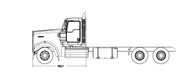
The BBC is exactly what it sounds like: the distance from the front face of the bumper to the back of the cab (not including any sleeper). It's a key indicator of your truck's hood length and, by extension, the size of the engine bay. You can find this spec by:
- Contacting a Peterbilt or Kenworth dealer with your VIN for a quick lookup
- Physically measuring it yourself—grab a tape measure and go from bumper to cab back, ignoring the sleeper if present
Keep in mind, the same truck model can come with different BBC options. For instance:
- A Peterbilt 357 might have a 111" BBC (short hood) or 119" BBC (longer hood)
- A Peterbilt 389 could be the "short hood" at 123" BBC or the long hood at 131" BBC
- Kenworth's W900B (120” BBC) vs. W900L (130” BBC) follows a similar pattern
- Even Freightliner models like the Cascadia offer a standard 125" BBC (fits both mid- and big-block) or a short 116" BBC (mid-block only)
Terminology like "short hood" or "long hood" gets thrown around loosely, which is why relying on the actual BBC number is crucial. Anything under 118" typically won't accommodate a big-block engine without major hassles.
Mid-Block vs. Big-Block Engines: Size Matters
In heavy-duty Class 7 and 8 trucks, engines generally fall into two categories based on their physical size and fitment requirements: mid-block (smaller, more compact) and big-block (larger and longer). Mid-block engines are designed to fit in both short-hood and standard-hood trucks, while big-block engines typically require more engine bay space—making them incompatible with hood configurations under 118" BBC without major modifications.
The key difference driving this fitment rule is overall engine length, particularly from the front (of the block) to the back (bell housing) of the engine. Big-block engines (generally 14-15L displacements) tend to be 4-8 inches longer on average due to larger blocks, extended crankshafts, beefier components, and additional accessories needed for higher power output. This extra length requires the radiator to set further forward, requiring a longer hood and greater BBC measurement.
Exact dimensions vary by model year, configuration (e.g., turbo placement, aftertreatment), and application, but here's a general comparison based on manufacturer data and industry specs:
- Mid-block engines (e.g., Paccar MX-13, Cummins ISX12/X12, CAT C12/C13): Approximate overall length 52-58 inches, width 35-40 inches, height 45-50 inches, dry weight 2,200-2,600 lbs
- Big-block engines (e.g., Cummins ISX/X15/N14, CAT C15/3406E, Detroit Series 60 12.7L/14L): Approximate overall length 57-67 inches, width 36-42 inches, height 48-54 inches, dry weight 2,800-3,200 lbs
The extra length in big-block engines comes from larger displacements (often 14-15L vs. 11-13L for mid-blocks) and beefier internals for higher torque and power. This is why a short BBC under 118" can't handle them—the hood simply isn't long enough.
Common Trucks with Short BBCs (<118") That Won't Fit Big-Blocks
While this isn't an exhaustive list, here are some popular Peterbilt and Kenworth models we frequently see in engine swap inquiries. These are typically short-hood configs with BBCs under 118", limiting you to mid-block engines:
- Peterbilt: 357-111, 365, 384, 567 short hood, 579 short hood
- Kenworth: T800 short hood, T880 short hood
On the flip side, models like the Peterbilt 389 short hood (123" BBC) or Kenworth W900B (120” BBC) both considered a short-hood truck but can still squeeze in a big-block. The rule applies across brands too—Freightliner's Cascadia-116 is another example where big-blocks are out.
Why Customers Get Burned: Real-World Conversion Pitfalls
We get calls daily from folks trying to upgrade from a mid-block to a big-block without realizing the BBC roadblock. Common scenarios:
- Clueless on Engine Sizes: Many people simply don't know the difference between mid- and big-block. They see a "Cummins" or "CAT" and assume it'll fit
- Halfway Through the Project: Picture this—the truck's torn apart, you've bought a big-block engine, and then you discover it’s hitting the firewall or cooling package. Refunds? Not likely. Downtime? Massive
- Buying a Donor Truck Blind: Purchasing a used rig with a mid-block specifically for a swap down the line when the engine fails, only to find the BBC is too short. This can waste tens of thousands on the truck, engine, and labor
The most frequent offender? Swapping out a Paccar MX-13. Since 2010, Paccar has been a factory staple engine in Peterbilt and Kenworth trucks, with millions on the road. It's a mid-block engine, so replacements are straightforward in short BBCs—but if you're eyeing a big-block like a Cummins ISX or CAT C15 for more power, check that measurement first. Our Paccar MX-13 vs. Cummins ISX article dives deeper into the nuances unique to replacing a Paccar engine, like brackets and the electronic interface.
Final Advice: Measure Twice, Swap Once
Engine conversions can breathe new life into your truck, boosting power, reliability, and efficiency. But skipping the BBC check is a recipe for regret. If you're planning a swap, start with your VIN and a dealer call, or measure it yourself. At Kustom Truck Parts, we're here to help with parts, advice, and custom solutions—contact us before you turn a wrench.
For more on donor trucks and conversion basics, read our guides on So You Have a Donor Truck and Engine Conversion Basics.
Ready to Repower Your Truck? Call Now: 1-888-564-8890
Mon–Fri 7AM–4PM PST | Speak with a repower specialist